






A Fraternal Struggle for the Bohemian Crown
On May 23, 1611, Matthias II, the younger brother of Rudolph II, was crowned King of Bohemia in St. Vitus Cathedral at Prague Castle. It should be added that this occurred with the emperor’s forced consent. Although Rudolph resided at Prague Castle, a mere few dozen meters from the venue of the ceremony, he did not attend the coronation festivities. Suffering from severe depression, he remained secluded in his imperial chambers. The path to the Bohemian throne had been neither easy nor swift for Matthias, and his Bohemian coronation marked the climax of a protracted personal conflict between the two brothers.
Personally, Matthias was a staunch Catholic and a proponent of centralizing efforts. Toward the Protestant estate assemblies in the Austrian lands, Hungary, and the Bohemian lands, however, he temporarily adopted a very conciliatory stance. He desperately needed allies. He deliberately projected an image of a future sovereign who championed religious tolerance and defended territorial liberties. This policy proved successful. In 1608, backed by the military support of the Hungarian, Austrian, and Moravian estates, Matthias marched into Bohemia in an attempt to force Rudolph’s abdication. The Bohemian estates exploited the conflict, securing from Rudolph the signature of the Letter of Majesty —guaranteeing religious freedoms—in exchange for their pledge of loyalty. Through this concession, Rudolph saved his Bohemian crown, but was forced to cede governance over Hungary, Upper and Lower Austria, and Moravia to his younger brother. He never reconciled himself to this humiliation and wove plans for revenge until the end of his life. A willing ally, albeit pursuing his own agenda, emerged in the person of Bishop Leopold of Habsburg (Passau). In January 1611, Leopold crossed the Bohemian border with his army and, in a swift march, seized several towns as well as Prague’s Lesser Town (Malá Strana). Despite initial successes, the position of the Passau troops became untenable in the following weeks. Under pressure from the territorial estates’ army, Leopold was forced to retreat, leaving the helpless Rudolph behind in Prague. The failed military campaign cost Rudolph the loyalty of the Bohemian estates, who offered the Bohemian crown to Matthias. He eagerly accepted it.
Matthias in Prague and His Mark on Bohemian Coinage
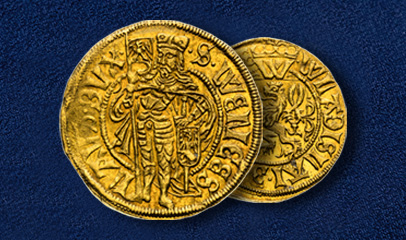
Despite initial expectations that the new king would quickly return to Vienna following the coronation, Matthias decided to prolong his stay in Prague. He used the time to reorganize affairs, earn the trust of the Bohemian estate community, and, last but not least, secure funds from an extraordinarily levied tax. His tactics included a showy respect for territorial liberties, the use of provincial symbols, and the fulfillment of at least some demands of the provincial diet that Rudolph II had ignored. This brief period of Matthias’s goodwill also left its mark on Bohemian coinage. On thalers from the years 1611–1613, the monarch’s head was temporarily adorned with the Bohemian royal crown, while the image of Saint Wenceslaus returned to the ducats from the beginning of Matthias’s reign.
Coinage in the Service of Imperial Representation
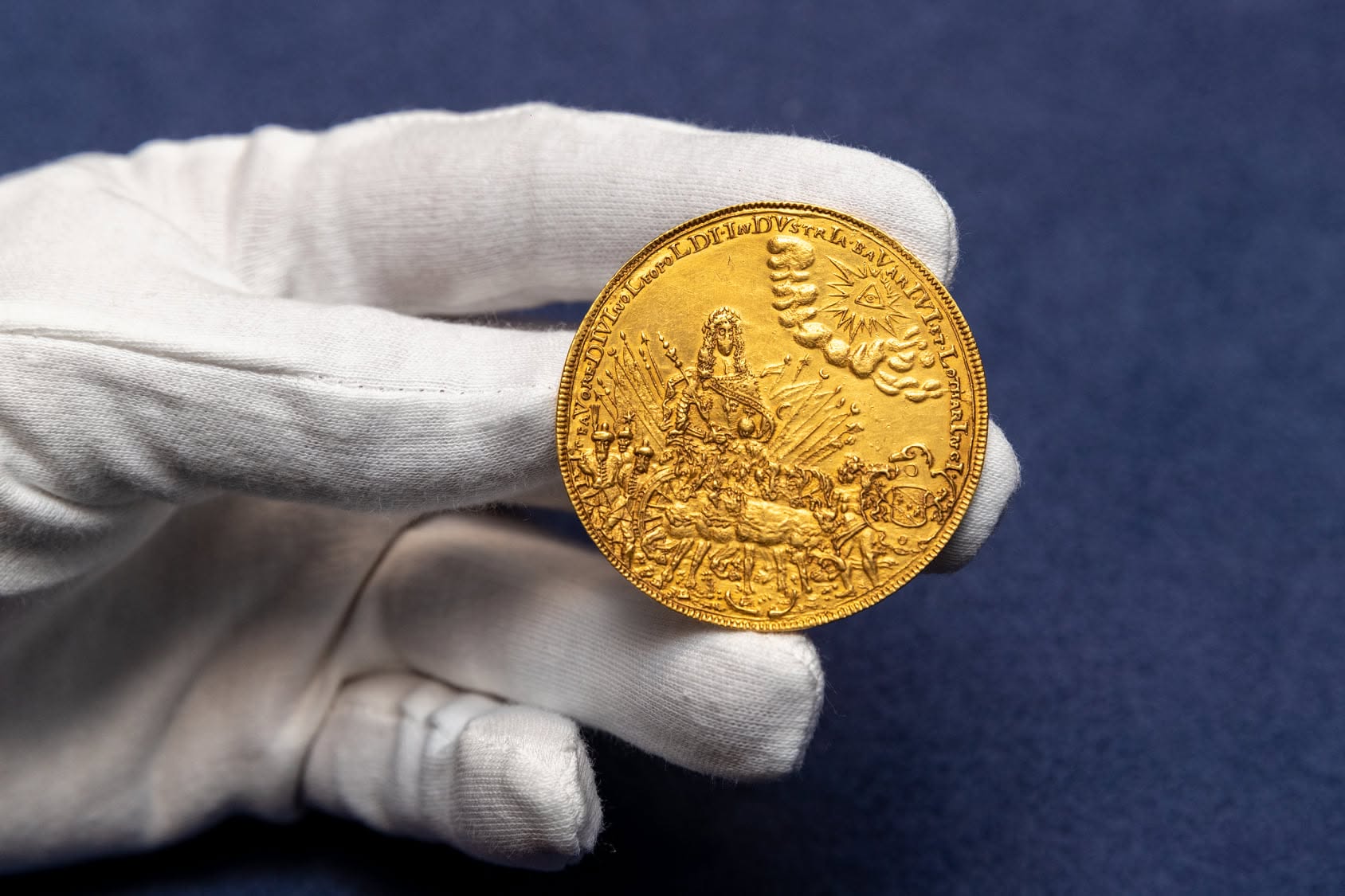
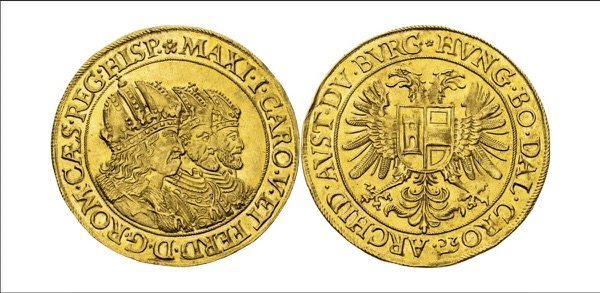
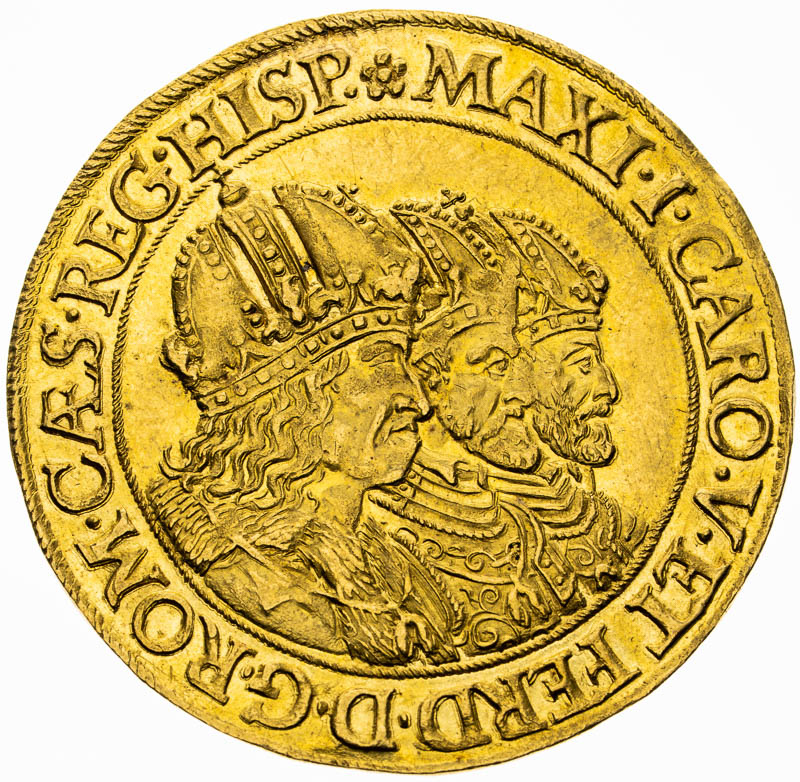
From the outset of Matthias’s reign, however, prestige thaler and ducat issues were minted in Bohemia whose purpose was not to enhance the glory of the Bohemian Kingdom, but to promote the power politics of the House of Habsburg. Ambitious Matthias, elected Holy Roman Emperor in June 1612, envisioned himself as its central pillar. To meet the needs of imperial presentation, particularly in connection with the imperial coronation in Frankfurt am Main, the Prague Mint struck 15-, 10-, 6-, and 5-ducat pieces, 3- and 2-thaler multiples, as well as thalers featuring the triple portrait of Emperors Maximilian I, Charles V, and Ferdinand I, combined with the portrait of Emperor Matthias or the depiction of the Habsburg double-headed eagle. A magnificent 5-ducat piece from this series in an extraordinary state of preservation will be auctioned in our 40th Auction as Lot 1078. These coins were not primarily intended for the domestic Bohemian public, but above all for prominent figures in European and Imperial politics. Artistically, these are truly extraordinary issues of exceptional craftsmanship. The dies were cut by Johann Konrad Greuter, an engraver and goldsmith of European renown residing in Prague since the early 17th century. They were modeled after the “Three Emperors” thalers (Dreikaiserthaler) struck in the 1560s in Tyrolean Hall and later in the 1590s in Joachimsthal (Jáchymov) in the Ore Mountains.
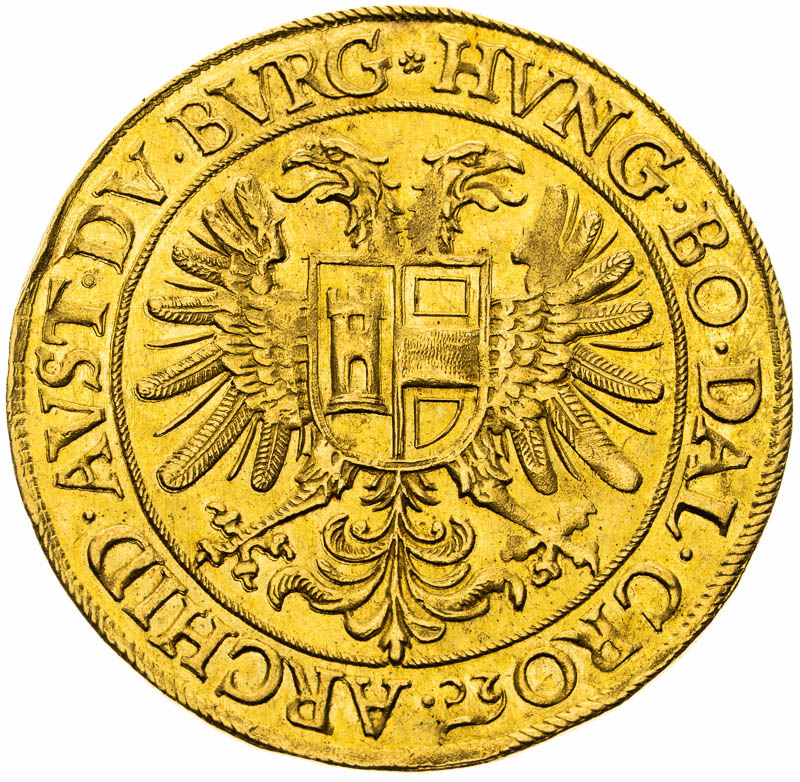
An Exceptional 5-Ducat Piece in Auction #40
Auction #40 – Lot 1078
5 Ducats. Prague.
RR | good EF | Starting price: €80,000
Highly collectible piece with beautiful patina. Remains of mint luster in the fields. From an old collection. Exceptional in its state of preserved condition because most of the coins of this type were provided with a loop and worn. Very rare! View auction lot →

