






From the Moravian treasury to the Duchy of Friedland
Even before the Thirty Years’ War, Wallenstein (Albrecht von Wallenstein) had decided to anchor his life’s prospects on close ties with the staunchly pro-Catholic Archduke Ferdinand of Styria, later Emperor Ferdinand II. Yet it was the war itself that provided him with the opportunity to draw major attention to himself. Serving as an officer of the Moravian Estates, he seized the Moravian Estates’ war treasury containing 100,000 florins in cash and delivered it to the Emperor in Vienna. This coolly executed and highly dangerous action vividly demonstrates Wallenstein’s fundamental character traits—unshakeable belief in his own abilities, grandiosity, and the capacity for swift decision-making. Following the defeat of the Estates’ Uprising, Wallenstein’s rise in power, wealth, and social standing gathered rapid momentum. Land speculation and advantageous purchases enabled Wallenstein to build a relatively cohesive territorial domain in northern and northeastern Bohemia, centered on the Friedland (Frýdlant) estate, which was later renamed, along with other possessions, the Duchy of Friedland. In 1627, Wallenstein was elevated to the rank of Imperial Prince. With the acquisition of the Duchy of Friedland, the Prince of Friedland also secured the privilege to strike coins of all denominations according to the imperial standard.
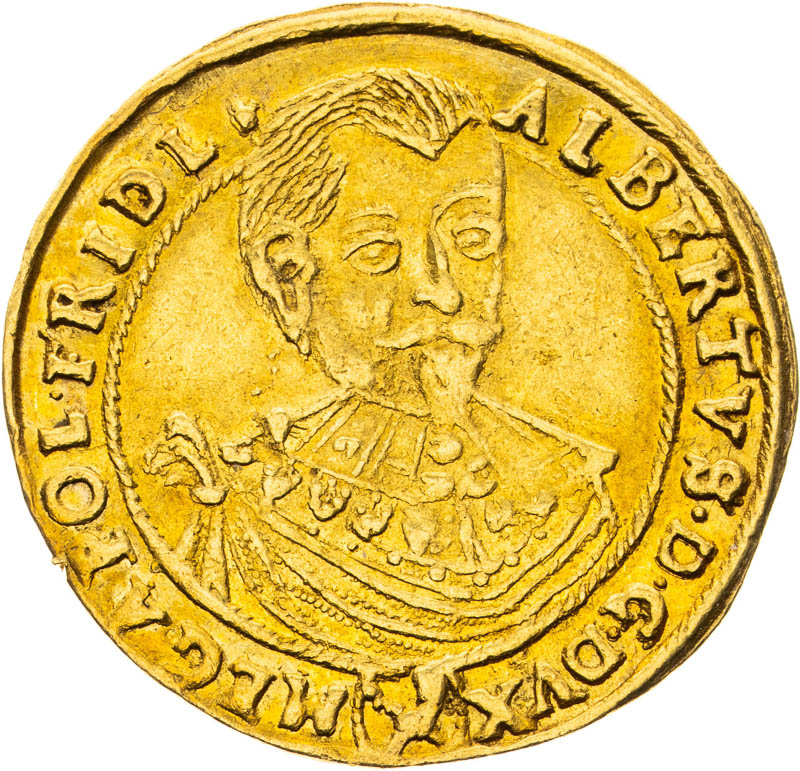
Obverse
Generalissimo and military entrepreneur
In 1625, the Prince of Friedland was appointed Generalissimo of the Imperial Army. Within a short time, he managed to build a formidable fighting force and achieved rapid military successes. He established control over vast territories in Holstein, Mecklenburg, and Pomerania. The size of his army expanded rapidly, and Wallenstein became an extraordinarily successful military entrepreneur. Operational costs were covered in part by the Emperor, but largely by the feudal lords in the occupied territories. War contributions became the driving engine of an economic cycle that spurred agricultural and artisan production across Wallenstein’s estates.
Fall and return to command
The rapid rise of the Duke of Friedland—by then also Duke of Sagan (Zaháň) and Mecklenburg—was temporarily halted by the Peace of Lübeck in 1629. Seeking a compromise with the Imperial Estates, the Emperor dismissed Wallenstein from supreme military command. The brilliantly organized war enterprise collapsed. In 1631, the Swedish army occupied the Duchy of Mecklenburg. In September of that same year, the Swedes defeated the Imperial forces at the Battle of Breitenfeld. While Wallenstein tallied his economic losses, Emperor Ferdinand II found himself in a critical predicament, lacking a battle-ready army. In this hopeless situation, reinstating Wallenstein as Commander-in-Chief of the Imperial forces became a mutual marriage of convenience. Wallenstein alone was capable of raising an effective military force in real time.

Reverse
A ducat from the year of triumph
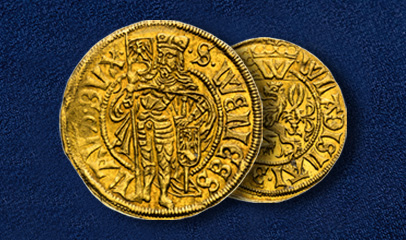
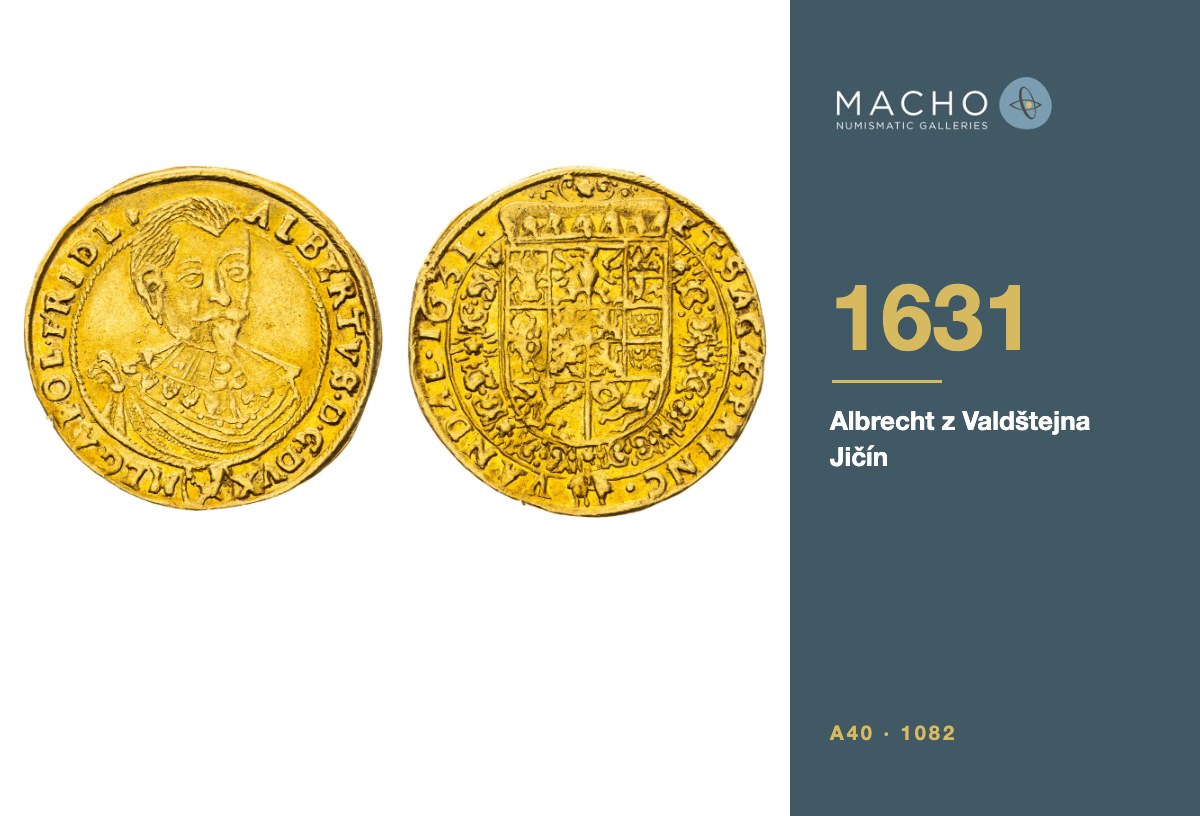
Thus, 1631 became a pivotal turning point for Wallenstein. Triumphant, he dictated harsh terms. It was precisely in 1631 that the ducal mint in Gitschin (Jičín) struck large quantities of gold and silver coins. One of these, a ducat bearing Wallenstein’s portrait, will be offered in our 40th Auction as Lot 1082. After 1631, Wallenstein became a power rogue, potentially dangerous to everyone. He manipulated himself into a position where virtually all parties agreed on the necessity of his removal. Following Wallenstein’s assassination in 1634, the Emperor ordered all Wallenstein coinage to be melted down under threat of asset forfeiture, with the metal reprocessed for imperial coinages.

