






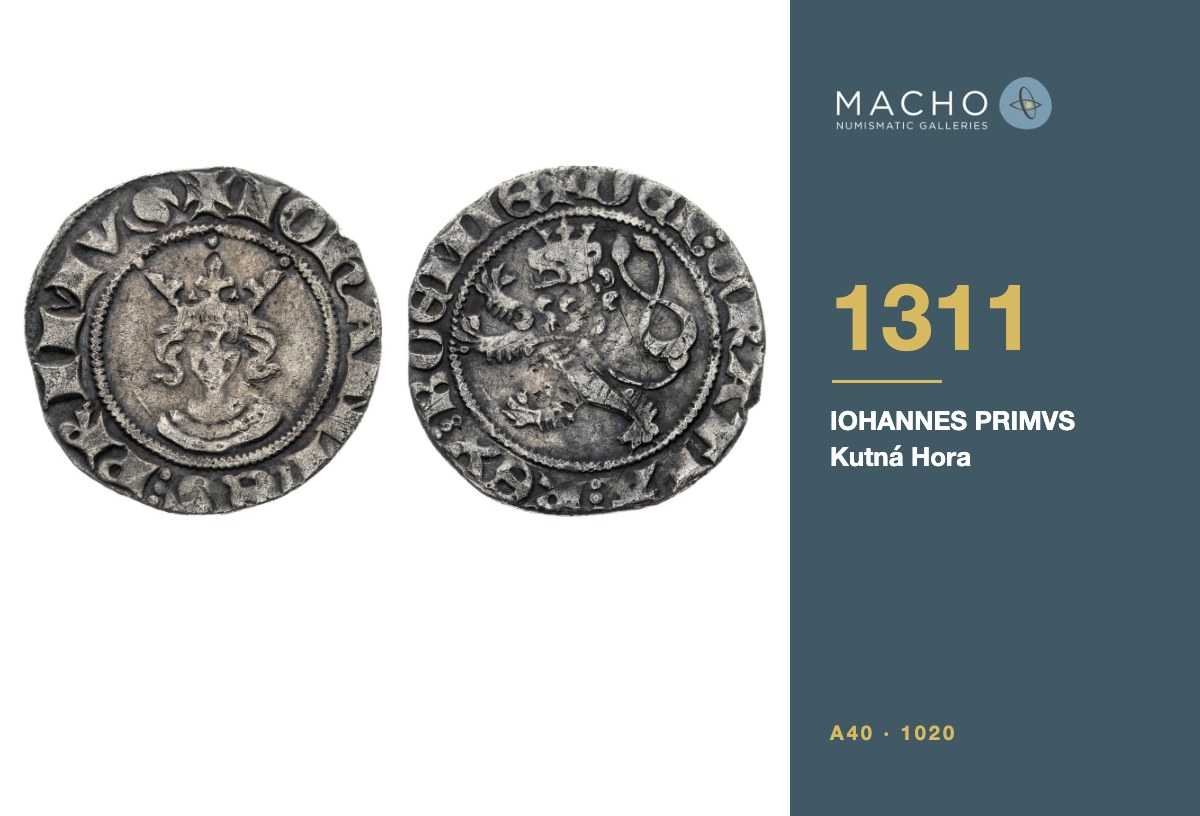
Half-groschen of the so-called English type (esterlin), Kuttenberg Mint
When the youthful John of Bohemia was crowned in Saint Vitus Cathedral on February 7, 1311, not only was a new dynasty ascending the Bohemian throne, but also a monarch of a completely different caliber than his Přemyslid predecessors. The son of Emperor Henry VII, educated in Paris at the French court of Philip IV the Fair, brought to Bohemia a cosmopolitan perspective and, among other things, a concept of a monetary system known in Western Europe—one richer in denominations and more finely graduated than the existing Bohemian system based on the Prague groschen and the small parvus.
Obverse
The only Bohemian ruler to strike the half-groschen
It was from this concept that one of the most remarkable and, at the same time, rarest undertakings of Bohemian coinage of the groschen period emerged—the half-groschen (půlgroš). John of Bohemia remained the only Bohemian ruler ever to mint this denomination. It was intended to fill a noticeable gap between the high-value Prague groschen and the minute parvus (weighing 1/12th of a Prague groschen), creating a natural intermediate step in the silver monetary system alongside the established gold florin. Mintage commenced at the very beginning of his reign, likely as early as the coronation year 1311, at the Kutná Hora (Kuttenberg) Mint in the Italian Court (Vlašský dvůr).
The English type – esterlin
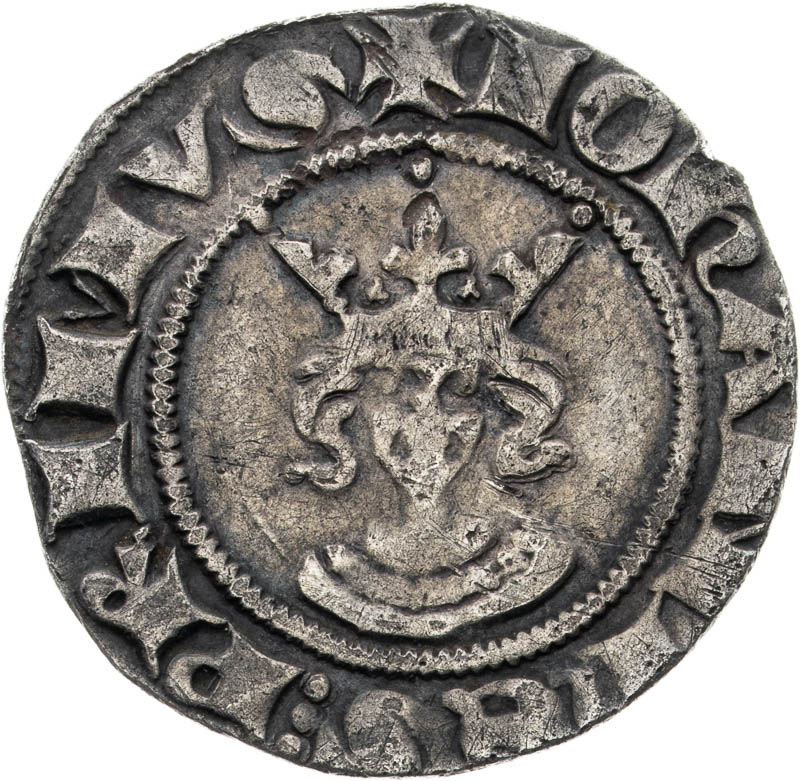
The offered specimen belongs to the so-called English type, also referred to as an esterlin. The obverse features the bust of the young crowned monarch, while the reverse depicts the Bohemian two-tailed lion; the legends containing the ruler’s name IOHANNES PRIMVS and title DEI GRATIA REX BOEMIE are distributed across both sides of the coin. The representation of the king is not a portrait in the true sense of the word, but rather a generic, idealized depiction of a young crowned ruler, inspired by the widespread Western European esterlin derived from the English sterling. It is precisely this connection to a foreign model that gave the type its name. According to the prevailing interpretation, the English type was very likely struck on the occasion of the royal coronation and can thus be understood as a coronation coin. It was soon replaced by the half-groschen of the so-called Bohemian type—a perfect miniature of the Prague groschen with a crown on the obverse—yet even this type failed to gain traction in circulation.

Reverse
Why the new denomination failed
The new denomination simply failed to take root. Most of the minted pieces were soon withdrawn from circulation and melted down, which explains their extraordinary rarity today: John’s half-groschens rank among the rarest surviving silver coins of the entire groschen period and are known in only a few specimens (RRR!). The intention itself to expand the domestic system with the missing intermediate step between the groschen and the small parvus was economically sound; however, it begs the question of whether its failure was foreshadowed by the coin’s design itself. The first, English type bore the ruler’s portrait—an element entirely unfamiliar in the domestic minting tradition accustomed to the crown and lion. Moreover, it was the image of a king from a new, foreign dynasty whose rule in Bohemia was not accepted without reservations, even if initially met with hopeful expectations. Perhaps that is why it failed to gain favor; and even the later return to the familiar iconography of the Prague groschen—a crown on the obverse and a lion on the reverse of the Bohemian-type half-groschen—could no longer overcome this initial disfavor. Paradoxically, the failure of the half-groschen only confirmed the viability of the pure groschen system, which remained the backbone of Bohemian coinage for more than two centuries.
The knight king and his coin
John of Bohemia closed his chivalric life story in true knightly fashion: blind, yet leading the charge at the Battle of Crécy on August 26, 1346. He left behind his son Charles, who became Holy Roman Emperor Charles IV and proved during his reign to be one of the most powerful rulers of the 14th century. The presented English-type half-groschen (Smolík 2, Castelin 8) in our 40th Auction as Lot 1020, with documented provenance (ex Aurea 74/2016, No. 426), is thus not merely a rare coin, but a tangible testament to the first years of the reign of a king who brought grand European politics back to Bohemian history.

