






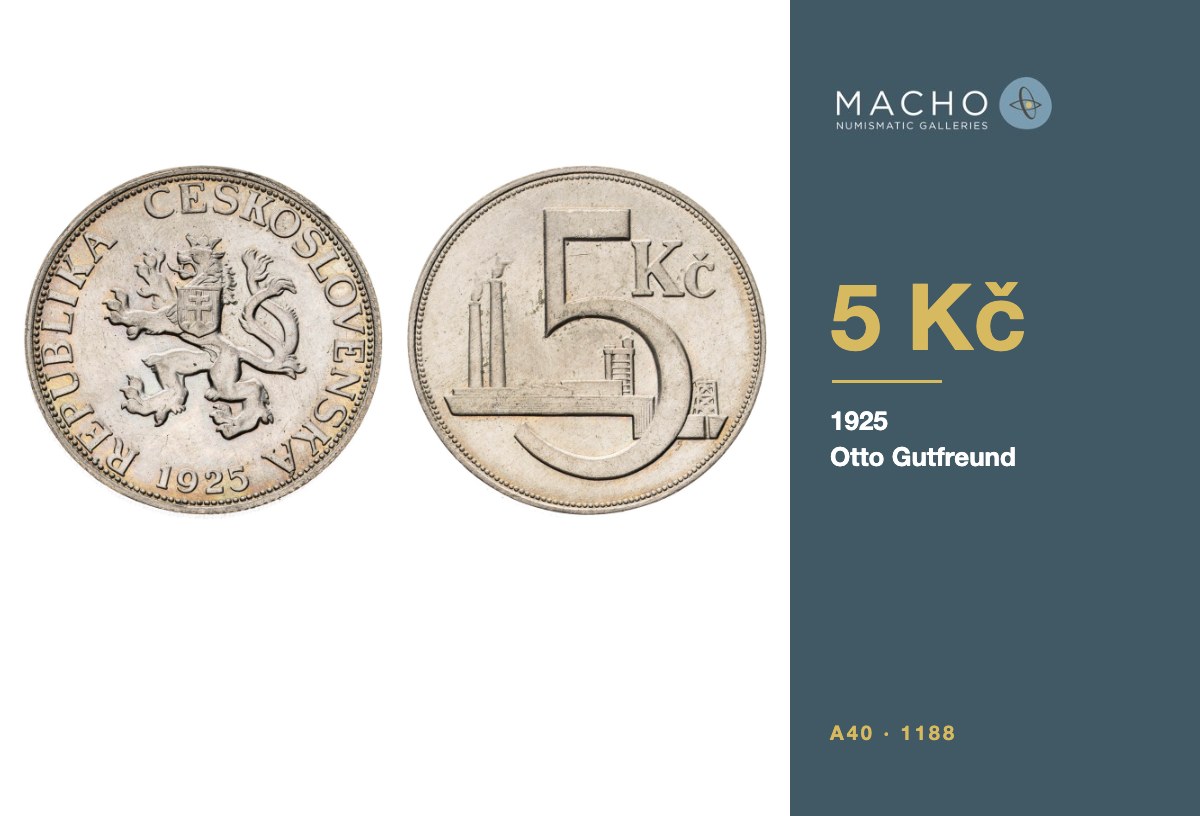
Combination of Otto Gutfreund’s Design and the Obverse from the 1921 20-Haléř Pattern
Although proposals for coins with a denomination of 5 Francs or 5 Sokols had already emerged during the formation of the monetary system of the newly established Czechoslovak Republic, the five-koruna coin was initially absent from the Czechoslovak monetary system. The first considerations of replacing the five-koruna banknote with a coin appeared at the Ministry of Finance in the summer of 1923. However, due to the considerable workload of the mint associated with the preparation and striking of Czechoslovak gold ducats, work on this denomination was temporarily postponed.
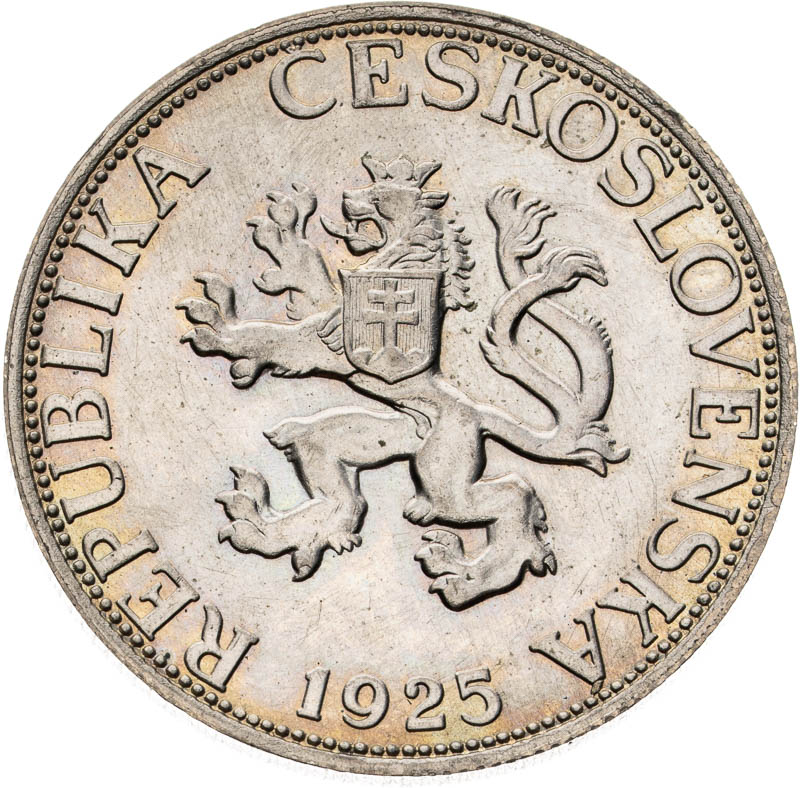
Obverse
Copper-nickel instead of silver
The mint returned to the five-koruna coin project at the beginning of 1924. Following a series of material tests, the original intention to strike the coin in silver was abandoned, and an alloy of copper and nickel in a ratio of 75:25 was selected as the most suitable material. A competition for the artistic design of the new coin was subsequently announced, which was won by the design of the prominent Czech sculptor and leading representative of Cubism, Otto Gutfreund.
Gutfreund’s design and its modifications
The preparation of the final dies, however, involved a number of modifications. For technical and practical reasons, Gutfreund’s original design had to be gradually adapted. Given the considerable time pressure under which both the mint and the artist were working, they collaborated closely on modifications to the individual models and dies. The changes concerned primarily the factory motif, the numeral “5” and the denomination mark “Kč” on the reverse, as well as the obverse bearing the national coat of arms. Several pattern strikes were therefore produced during this process, documenting the individual stages in the development of the coin.
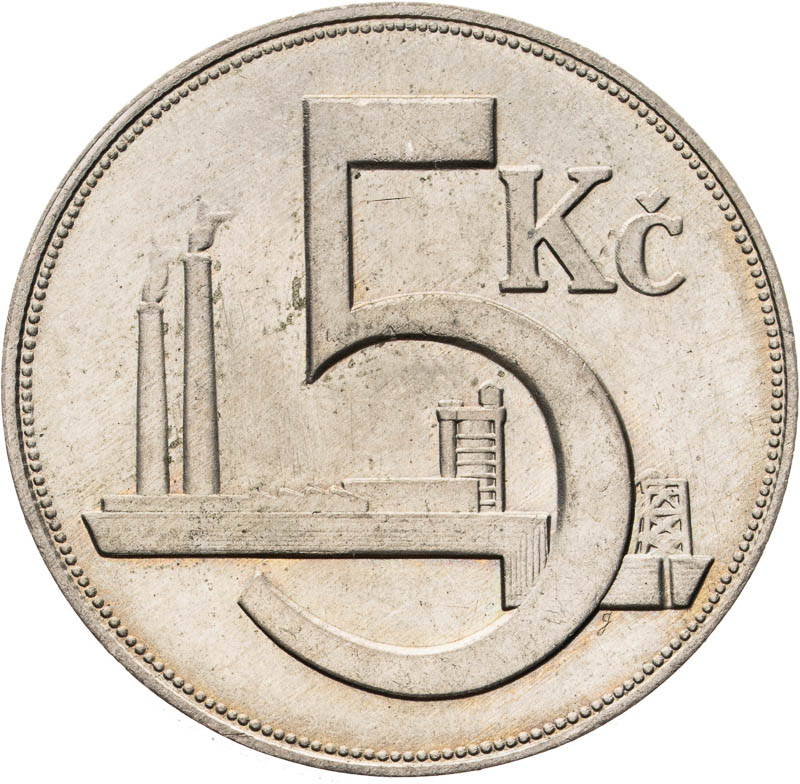
Reverse
Dated 1921, struck in 1925
One of these pattern strikes is the presented variant, featuring the reverse based on Gutfreund’s design, while the obverse bears a design adopted from the 1921 pattern strike of the 20 Heller coin, created by the mint’s engravers in 1921. Of particular interest is the fact that, although the pattern specimen bears the date 1921, the actual coin was produced only at the beginning of 1925. According to the findings of R. Havel, author of a monograph devoted to Czechoslovak pattern strikes, there are no archival records documenting the production of this particular pattern. It is nevertheless likely that it was produced at the initiative of the mint as a specimen illustrating the proposed modifications for the Ministry of Finance.
Only two specimens known
The exact number of pieces struck in this variant is unknown. It may reasonably be assumed, however, that no more than a few specimens were produced. Apart from the example offered in the present auction, only one other specimen is known, bearing the additional counterstamp “ZKOUŠKA”, which is held in a private collection. The presence of this pattern strike in the collection of the prominent banker František Trefanec also demonstrates the appeal of collecting pattern strikes as early as the post-war period.

